

What Makes Me Unique in God's Kingdom?
“You don't create your distinction. You discover it.”
— Annemarie Cross
What makes me unique?
It's a question we can easily answer by looking outward.
What do I do that someone else isn't doing?
What knowledge do I have that others don't?
What gift, qualification, experience or expertise sets me apart?
And if we struggle to find something sufficiently unusual, we can quietly conclude:
Perhaps there isn't anything particularly distinctive about me.
After all, someone else has your qualification.
Someone else works in your profession.
Someone else has experienced something similar.
Someone else serves the same kind of people.
Someone else can teach, encourage, organise, lead, create, listen, write, nurture, build or solve problems too.
But what if uniqueness in God's Kingdom was never meant to be measured by finding the one thing you possess that nobody else does?
What if the better question is:
What has God uniquely brought together in me — and how might He desire me to steward it for the benefit of others?
Because your distinction isn't something you need to manufacture.
It is something to recognise.
And sometimes the very things most worth recognising are the things we have been quickest to dismiss.
What If We've Been Looking for Significance in the Wrong Places?
We live in a world that frequently connects identity with vocation.
One of the first questions we're asked when meeting someone is:
“What do you do?”
Our answers quickly become shorthand for who we are.
A teacher.
A business owner.
A mother.
A lawyer.
A pastor.
A nurse.
A coach.
Retired.
Unemployed.
And without realising it, vocation, productivity, achievement and visibility can begin influencing our perception of significance and even worth.
The Kingdom of God begins somewhere very different.
Our identity is first found in Christ.
“For you died, and your life is now hidden with Christ in God.”
— Colossians 3:3
Before considering what makes our contribution distinctive, this matters.
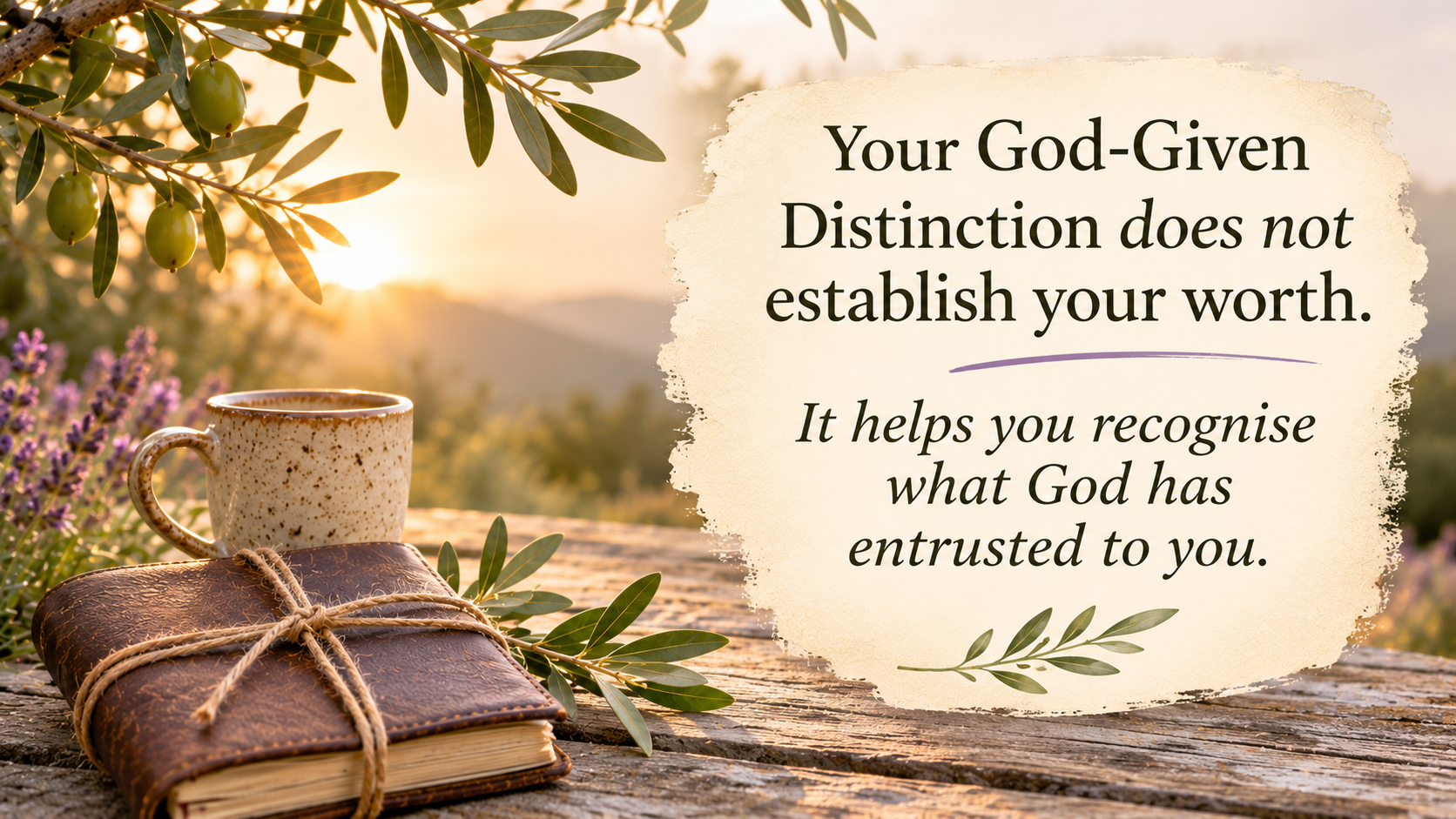
Your God-Given Distinction does not establish your worth.
Your worth isn't waiting to be earned through discovering an impressive purpose, fulfilling a particular role or becoming useful enough to God.
God-Given Distinction helps us recognise something different:
how God has uniquely created, formed and prepared us, and what He has entrusted to us that can be faithfully expressed for His purposes.
That means significance cannot be reduced to a job title.
And contribution cannot be measured only by what is visible.
“All I Can Do Is Talk”
My mother used to say something that has stayed with me.
Even in her mature years she would say:
“I don't really have anything to offer. All I can do is talk.”
But what she called talking was far more than talking.
She lived in a retirement village and would tell me she was going to visit “all the oldies” — even though, by then, she was of mature age herself.
She genuinely enjoyed people.
She was interested in their lives.
She would listen to their stories — even when she had heard the same story before.
She kept little notes beside people's names so she could remember who she had visited and who might need another visit.
She remembered birthdays so she could send cards.
She gave people her time.
Her attention. Her interest. Her company.
And she enjoyed doing it.
For me, hearing the same story over and over would probably have been the opposite of joy!
But that's partly the point.
What felt ordinary and enjoyable to her wasn't necessarily ordinary to somebody else.
She saw:
“All I can do is talk.”
But underneath that simple description were relational capacities she hadn't necessarily recognised as significant:
Listening.
Remembering.
Noticing.
Patience.
Conversation.
Encouragement.
Genuine curiosity about another person's life.
And the intentionality to make sure people weren't forgotten.
What did those abilities produce?
They may not have produced something easily measured.
But perhaps they produced companionship. Belonging. Encouragement. Dignity.
The experience of being remembered. A little less loneliness.
Sometimes what we dismiss because it doesn't appear impressive may be precisely what becomes meaningful in someone else's life.
Difficult to measure does not mean insignificant in the Kingdom of God.
What Follows the Words “All I Do Is…”?
Perhaps you've said something similar.
All I do is listen.
All I do is encourage people.
All I do is organise things.
All I do is cook.
All I do is look after my family.
All I do is help behind the scenes.
All I do is explain things.
All I do is notice when someone isn't okay.
There can be something revealing about the words:
“All I do is…”
They can expose where familiarity has caused us to diminish something simply because it comes naturally.
Of course, not everything we enjoy or do easily is automatically part of our God-Given Distinction.
But perhaps the sentence that follows “all I do is…” deserves another look.
What comes naturally to you?
What do you notice that others sometimes miss?
What do people repeatedly appreciate about you?
What seems almost too obvious to mention because you've always been able to do it?
What brings life to other people when you offer it?
Sometimes what is hardest to recognise about ourselves is what has been present for so long that we stopped noticing it.
Distinctiveness Can Emerge Through Combination, Not Rarity
We can also make the mistake of searching for one extraordinary quality that proves we are unique.
But God's design is more intricate than that.
Your distinction isn't necessarily located in one rare ability.
It becomes recognisable through the way different aspects of who you are have been brought together.
Your capacities.
Your experiences.
Your character.
Your perspective.
The way you process information.
What you notice.
The questions you ask.
The things you've learned.
The convictions that have been established within you.
The way you communicate.
How you approach problems.
The people you naturally connect with.
The way you express what you know.
Individually, many of these qualities may be shared by countless other people.
Their particular convergence within one person is another matter.
Think of two people with the same qualification.
They may possess similar knowledge and technical ability.
Yet one has a remarkable capacity to take something complex and make it simple. The other notices patterns others overlook.
One creates an immediate sense of safety in conversation. Another asks questions that cause people to think differently.
One is energised by beginning something new. Another can see precisely what needs refining.
The qualification may be the same.
The expression is not.
Distinctiveness can emerge through combination rather than rarity.
The Distinction Triad: Design, Formation and Expression
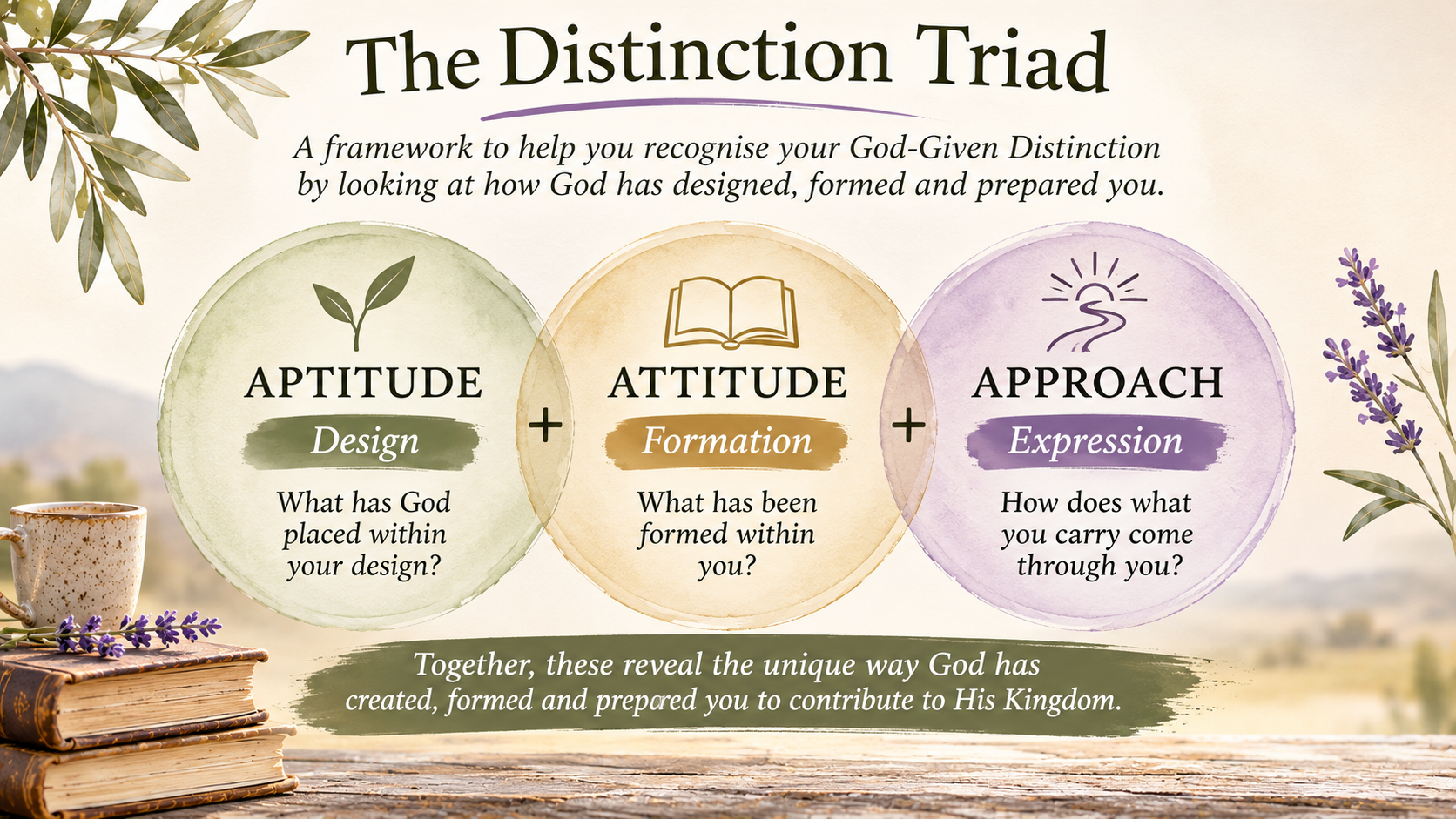
One of the ways I help people begin recognising their God-Given Distinction is through what I call the Distinction Triad:
Aptitude — Design
What has God placed within your design?
This can include natural capacities, strengths, ways of thinking, abilities, tendencies and patterns of perception.
What seems to come naturally?
What are you able to see, understand, create or do?
Attitude — Formation
What has been formed within you?
This includes character, convictions, perspective, maturity and the lessons that have shaped the way you understand and respond to the world around you.
Formation happens across a lifetime.
Approach — Expression
How does what you carry come through you?
How do you communicate?
Solve problems?
Teach?
Create?
Lead?
Serve?
Relate?
Encourage?
Bring ideas into reality?
Two people can share a similar aptitude and still express it very differently because their formation and approach are different.
This is why simply identifying a list of strengths rarely tells the whole story.
We begin to see more when we consider Design, Formation and Expression together.
Your Distinction Can Be Expressed Differently in Different Seasons
There is another reason we can struggle to recognise what God has placed within us.
We're often looking for one permanent expression.
One vocation. One ministry. One role. One obvious place where our uniqueness “fits.”
But life has seasons.
When my children were young, one of the most significant places I could express what God had placed within me was through raising them.
Teaching them the ways of the Lord. Encouraging them. Supporting them as best I could. Noticing their emerging talents and interests. Helping them develop the things God had placed within them.
Years later, some of those underlying threads can be recognised in very different contexts — mentoring, teaching, developing frameworks, asking questions, recognising possibilities and helping women identify what God may already have placed within them.
The context changed.
The expression changed.
But when I look backwards, I can recognise threads that were present long before I had language for them.
This matters because sometimes we think we aren't doing anything significant with what God has given us simply because our current season doesn't look like the expression we imagined.
A woman may be raising children.
Caring for an ageing parent.
Studying.
Building a business.
Teaching in a classroom.
Leading an organisation.
Serving within her church.
Recovering after a difficult chapter.
Mentoring one person.
Supporting a spouse.
Welcoming people into her home.
The question isn't merely:
“Where is my platform for this?”
A better question might be:
“How is what God has placed within me being expressed and stewarded in this season?”
Have We Mistaken Visibility for Significance?
This may be one of the most important questions we can ask.
Because Kingdom contribution isn't always visible.
Jesus told His followers:
“You are the salt of the earth…”
“You are the light of the world…”
— Matthew 5:13–14
Salt doesn't need a platform to have an effect.
Light doesn't need a title before it can illuminate what is around it.
Sometimes expressing the love of God looks remarkably ordinary.
A friendly word.
A meal prepared for someone who is struggling.
A card sent because you remembered.
Making room at your table.
Praying with someone.
Offering practical help when life has become overwhelming.
Sitting beside someone who is grieving.
Listening without rushing them.
Using your professional expertise to help solve a problem.
Seeing the person others seem to overlook.
What appears to be a small gesture to the person offering it can arrive at precisely the moment somebody else needed it.
A dinner may simply look like dinner.
But to the exhausted mother, grieving neighbour, struggling family or person facing illness, it may communicate something much larger:
I was seen.
I was remembered.
Someone cared.
And through the ordinary faithfulness of one of His people, someone may encounter an expression of God's love.

The Body Needs Different Parts
Paul gives us another powerful picture in 1 Corinthians 12.
The Church is described as a body.
One body. Many parts.
“Now you are the body of Christ, and each one of you is a part of it.”
— 1 Corinthians 12:27
The eye isn't asked to become the hand.
The ear isn't considered deficient because it cannot see.
Difference isn't presented as something that needs to be eliminated.
It is necessary.
And Paul makes the striking observation:
“On the contrary, those parts of the body that seem to be weaker are indispensable…”
— 1 Corinthians 12:22
God-Given Distinction isn't about becoming more important within the Body.
It is about recognising how we have been equipped to contribute to it.
And when we fail to recognise what we carry because it seems ordinary, unimpressive or less visible than someone else's contribution, we may inadvertently neglect something that was never insignificant to begin with.
Same Assignment. Different Distinction.
This is also why two people can have the same broad assignment and bring something very different to it.
Consider two mothers raising children.
Both love the Lord. Both desire to teach their children His ways. Both are faithfully stewarding the responsibilities of motherhood.
Yet they may create completely different environments because each woman brings her own design, formation and approach into that assignment.
One may naturally teach through conversation. Another through creativity.
One may be highly structured. Another particularly perceptive about emotions.
One may love opening her home and creating community around the family. Another may have an extraordinary capacity to recognise and develop each child's individual abilities.
Same broad assignment. Different distinction.
And later:
Different season. Different assignment. Same woman. Recognisable threads.
This is one reason our God-Given Distinction should never be reduced to a job title.
A job can change.
An assignment can end.
A season can close.
Yet something of the way God has created, formed and prepared us may continue finding new expressions.
Pain Isn't Your Distinction
Our formation also includes experiences we would never have chosen.
Disappointment.
Failure.
Loss.
Betrayal.
Rejection.
Mistakes.
Seasons of being misunderstood.
That doesn't mean every painful experience was deliberately caused by God in order to prepare us.
We live in a broken world. Other people make choices. We make choices. Things happen that God never called good.
Yet redemption means those chapters do not have to remain meaningless.
God can heal.
Restore.
Teach.
Mature.
Bring wisdom.
Deepen compassion.
Establish conviction.
And sometimes what has been formed within us through the journey changes how we are able to recognise, understand or serve someone else.
But there is an important distinction:
Pain itself isn't your distinction.
Your wounds aren't your qualification.
What God heals, restores, teaches and establishes within you through the journey, however, may become part of what you faithfully carry forward.
If you have ever wondered whether difficult or unexpected chapters mean you have somehow missed what God intended for your life, you may also find this resource helpful:
READ: Have I Missed God's Plan for My Life?
Sometimes What We Carry Has Been Hidden
There is another reason we may struggle to recognise our distinction.
Sometimes we didn't simply overlook it.
Sometimes we learned to hide it.
Perhaps you spoke and were criticised.
You asked questions others didn't want asked.
You saw something differently and were dismissed.
You brought an idea forward and were ridiculed.
You were told you were too much.
Too sensitive.
Too intense.
Too ambitious.
Too quiet.
Too different.
Or perhaps something you offered was rejected at a vulnerable point in your life.
Over time, it can feel safer to suppress what once came naturally.
So the question isn't always:
“What makes me distinctive?”
Sometimes another question needs to come first:
“What have I learned to mistrust, minimise or hide about the way God created me?”
Recognition may involve noticing not only what has always been present, but where hurt has distorted how we interpret it.
Distinction Isn't Superiority
Recognising God-Given Distinction isn't an invitation to rank ourselves against other people.
It doesn't mean:
I am more gifted.
My contribution is more important.
My way is better.
In fact, Paul's picture of the Body gives us the opposite posture.
We need one another.
Someone else's brilliance doesn't diminish what God has entrusted to you.
And what God has entrusted to you doesn't diminish what He has placed within them.
Comparison asks:
“How do I measure against her?”
Recognition asks:
“What has God entrusted to me?”
Those questions lead in very different directions.
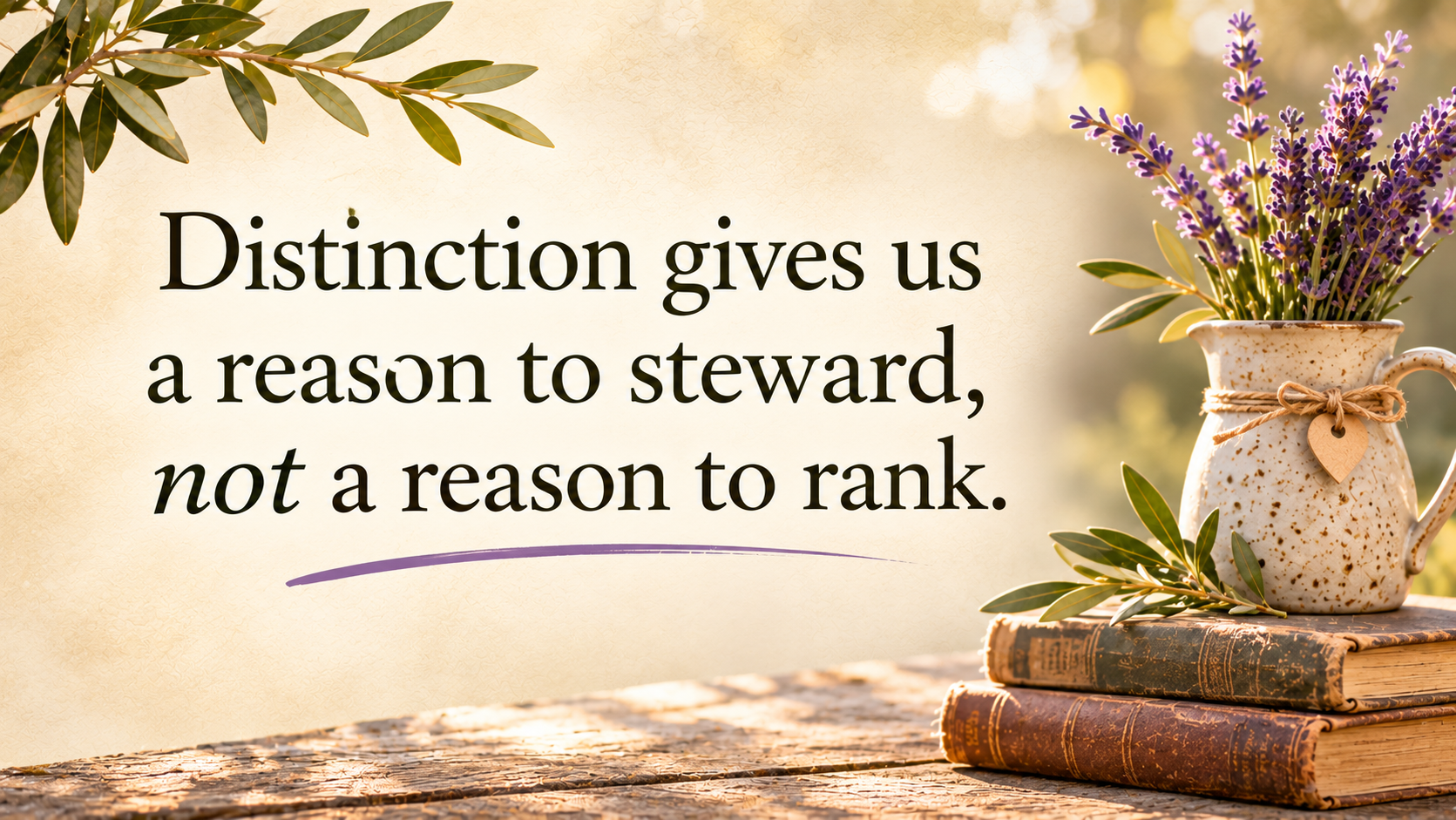
Distinction gives us a reason to steward, not a reason to rank.
Perhaps You're Already Expressing It
Sometimes we imagine God-Given Distinction as something hidden somewhere inside us that we need to discover before we can begin expressing it.
But there may already be evidence. Look backwards.
What do people repeatedly come to you for?
What do they thank you for?
What do you instinctively notice?
What seems obvious to you but isn't obvious to others?
What kind of problems do you naturally begin solving?
What do you make easier for people to understand?
Which themes continually appear across different chapters of your life?
When do you feel a deep sense of:
“This matters.”
What kind of contribution brings life to you while also benefiting somebody else?
And perhaps return to that deceptively simple question:
What do you keep describing as “all I do is…”?
There may be something there worth looking at again.
If you're also discerning how what you're recognising relates to calling and the assignments God may entrust to you in different seasons, you may find this resource helpful:
READ: How Do I Know What God Is Calling Me to Do?
Recognition Creates Responsibility
Perhaps the reason it matters that we recognise how God has uniquely created, formed and prepared us isn't so that we can prove we're different.
It's so that we stop overlooking what He has already placed within us that could become a blessing in the lives of others.
Recognition changes the question.
Instead of:
“What makes me special?”
we can begin asking:
“What has God entrusted to me — and how can I steward it faithfully?”
Develop it.
Strengthen it.
Give language to it.
Use it.
Offer it.
Bring it into service of others.
Sometimes that may happen before thousands of people.
Sometimes before ten.
Sometimes around your dinner table.
And sometimes it may happen in a quiet conversation with one person who simply needed somebody willing to listen.
The size of the audience doesn't determine the faithfulness of the offering.
What God has made distinctive in you isn't merely something to recognise.
It is something to steward.
A Reflection Before You Leave
Consider these questions slowly rather than trying to answer them all at once.
What comes naturally to me that I may have dismissed because it feels ordinary?
What follows the words “all I do is…” in my own life?
What do others consistently recognise, appreciate or seek from me?
What recurring threads can I see across different seasons, roles and assignments?
Where might I have mistaken visibility, vocation or achievement for significance?
Has criticism, hurt or rejection caused me to hide or mistrust an aspect of how I naturally express what I carry?
What becomes visible when I consider my design, formation and expression together rather than separately?
Who has God placed around me in this season who may be blessed through something He has already placed within me?
What might faithful stewardship of what I'm recognising look like now?
Perhaps there is more to what you carry than you have recognised.
Not because you need to become more important.
But because every member of the Body has a part to play, and even what seems ordinary can become a meaningful expression of God's love when faithfully placed in His hands.