

How Do I Know What God Is Calling Me to Do?
“Sometimes the difficulty isn't that God hasn't been leading. It's that we're trying to recognise an assignment before we've understood what kind of calling we're looking for.”
— Annemarie Cross
What is God calling me to do?
Perhaps you've asked that question while standing at a crossroads. Or because something has been stirring that you can't quite name.
Maybe there is a particular group of people you keep noticing. An issue you cannot seem to ignore. A message that continues resurfacing. Or perhaps something that once felt clear has changed, and you're trying to discern what faithfulness looks like in this season.
For many Christians, the word calling carries enormous weight.
We can begin searching for the calling — the role, ministry, business, vocation or assignment that will finally explain what we're here to do.
And when we can't identify it, we can wonder whether we've missed something.
But perhaps some of the confusion comes from using the word calling to describe several things that aren't quite the same.
Because the question: “What is God calling me to do?” may actually contain several different questions.
Who has God called me to?
How has He created and prepared me to contribute to His Kingdom purposes?
And what is He entrusting to me here, in this particular season, situation or moment?
Recognising the difference between these questions can change the way we discern calling altogether.
Your Calling Begins With Christ
Before calling describes an assignment, it describes a relationship.
Throughout the New Testament, believers are described as those called by God — called to belong to Christ, called into fellowship with Him, called to holiness and called according to His purpose.
Paul writes:
“God is faithful, who has called you into fellowship with his Son, Jesus Christ our Lord.”
— 1 Corinthians 1:9
This is what I describe as our Primary Calling.
We are first called to Christ.
That distinction matters.
When the question of calling begins only with What am I supposed to accomplish?, calling can quietly become centred around output — what we build, lead, achieve, produce or become known for.
But our doing flows from belonging.
Before there is a platform, profession, ministry, business, project or role, there is Christ.
And it is from that relationship that everything else is discerned.
Calling and Assignment Are Not the Same Thing
This is where an important distinction can help.
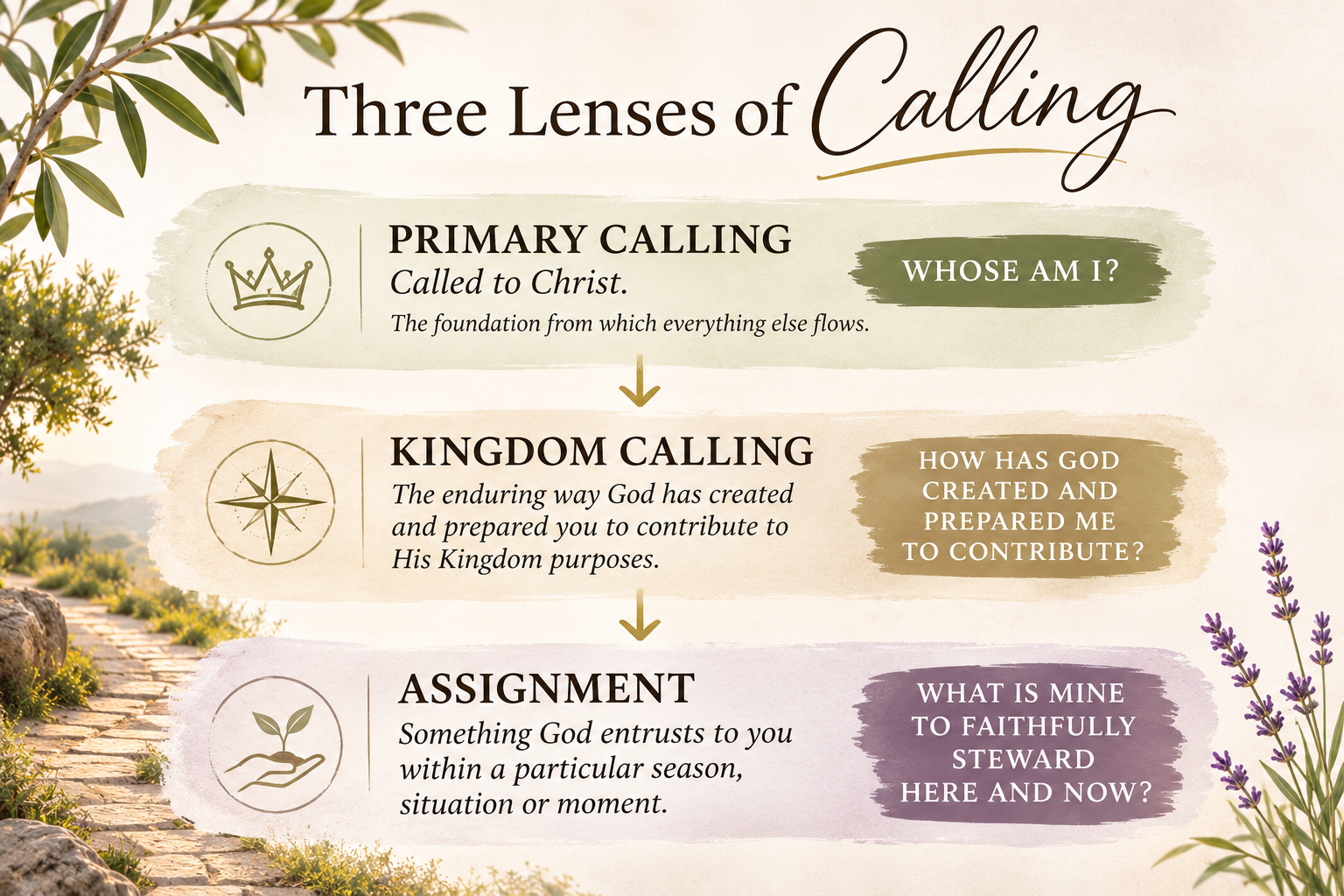
I describe calling through three different lenses:
Primary Calling
Called to Christ.
This is the foundation from which everything else flows.
Kingdom Calling
The enduring way God has created and prepared you to contribute to His Kingdom purposes.
It may become recognisable through recurring themes, people you are drawn to serve, burdens you carry, capacities God has developed, truths you continually return to and the distinctive way you engage with what He places before you.
Assignment
Something God entrusts to you within a particular season, situation or moment.
An assignment is an expression of faithfulness within a particular context. And this is where I believe we sometimes confuse things.
An assignment might last twenty years. It might last a season. It might be a particular role, ministry, business, project or responsibility. Or it might last for a moment.
Its duration doesn't determine its significance.
What makes it an assignment is that something has been entrusted to us within a particular context that calls for a faithful response.
Sometimes the Assignment Is Proximity
Consider Esther.
Esther didn't orchestrate the crisis threatening the Jewish people. Yet through a series of circumstances, she found herself in a position of extraordinary proximity.
She had access to the king.
Mordecai recognised the significance of where she had been positioned:
“And who knows but that you have come to your royal position for such a time as this?”
— Esther 4:14
Her proximity created the possibility of intervention.
And then there is Jael. Her story in Judges 4 is remarkably different. Sisera, commander of the Canaanite army, fled from battle and arrived at Jael's tent.
She wasn't on the battlefield pursuing him. The assignment came within her sphere. She had proximity to the man God had determined would fall into the hands of a woman.
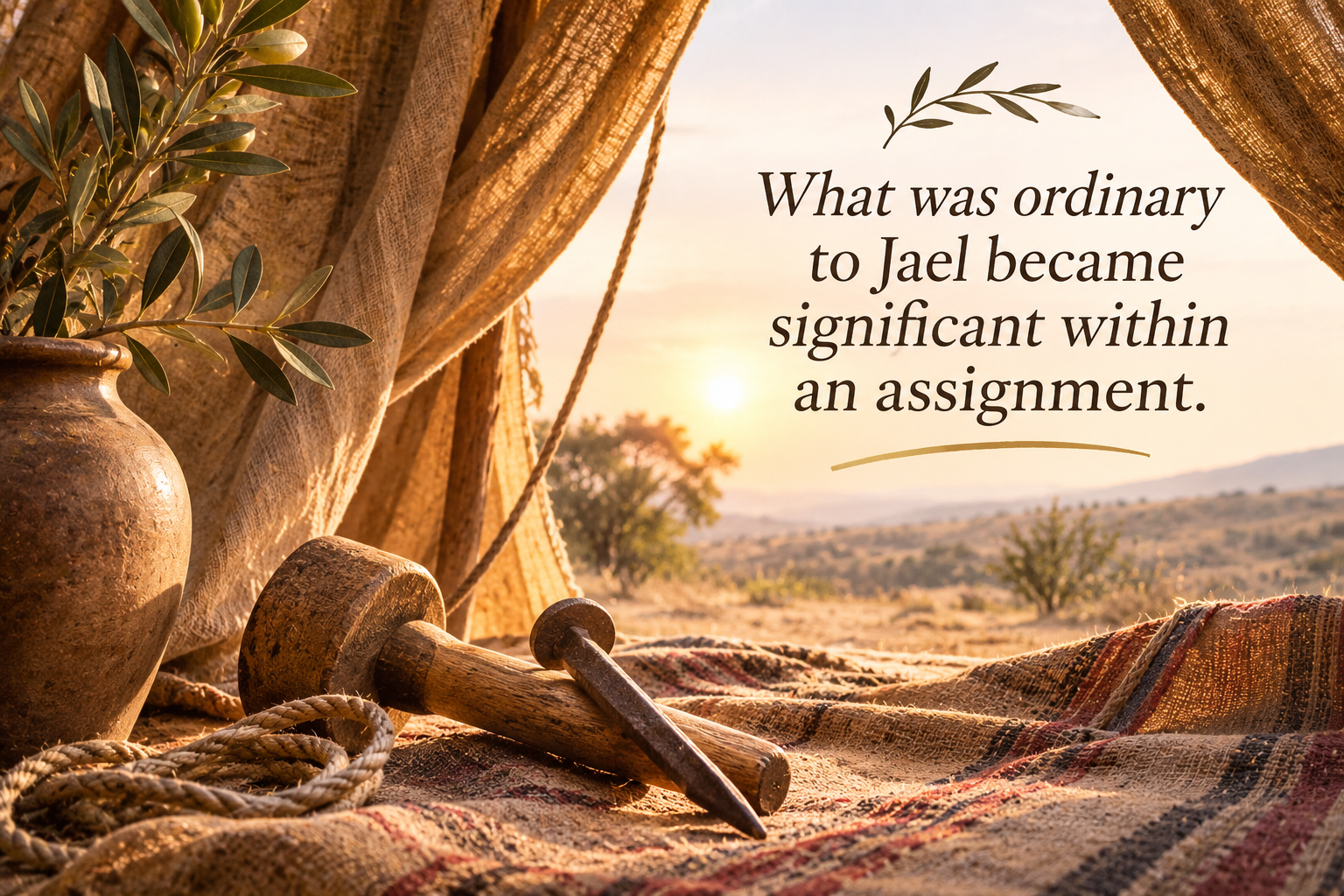
And when the moment came, Jael used what was already within her world — a tent peg and hammer.
Two women.
Two very different situations.
Two moments where proximity mattered.
And this raises an important question when we're discerning what God may be asking of us:
Who or what has God placed me in proximity to?
Perhaps it is a person.
A conversation.
A workplace.
A community.
A problem.
An opportunity.
A moment requiring courage.
Something you know.
Something you carry.
Something already within your hands.
Sometimes an assignment isn't something we go looking for.
It arrives within the sphere of what God has already placed within our reach.
But Proximity Doesn't Automatically Mean Assignment
There is an important distinction here too.
Being able to see a need doesn't automatically mean we have been assigned to meet it.
Being capable of helping doesn't automatically mean the responsibility belongs to us.
And having access to someone doesn't necessarily mean God has appointed us to intervene in their situation.
This is particularly important for people who are compassionate, responsible or quick to recognise what needs to be done.
Without discernment, we can begin carrying responsibilities the Lord never entrusted to us.
So proximity can cause us to pay attention. But proximity alone doesn't establish assignment.
Discernment asks:
“Lord, what is mine to faithfully respond to here?”
There will be times when the answer calls us to step forward.
There will also be times when faithfulness means recognising that something belongs in somebody else's hands.
The question isn't simply:
Can I do something?
It is:
Is this mine to steward?
What Has Become Ordinary to You?
There is another detail in Jael's story worth noticing.
The tool she eventually used wasn't extraordinary to her world.
It was a tent peg.
Jael belonged to a nomadic community. Pitching and dismantling tents would have been part of ordinary life. The very thing that became significant in that moment was something familiar.
And I wonder how often we overlook what God may use because it has become ordinary to us.
A skill you've used for years.
Knowledge you've accumulated.
Relationships you've built.
Experience gained through work or life.
Access others don't have.
A capacity you've developed.
Credibility you've earned.
A way of seeing something that feels obvious to you but isn't obvious to others.
A question you continually find yourself asking.
We often discount these things precisely because they are familiar.
Yet sometimes what appears ordinary outside an assignment becomes remarkably significant within one.
So perhaps another question worth asking is:
What has become so ordinary to me that I may have stopped recognising its significance?
Not because everything we possess is destined for some dramatic moment.
But because faithful stewardship begins with recognising what has already been entrusted.
Look for the Threads That Keep Appearing
While an assignment may belong to a specific moment, Kingdom Calling has a different quality.
It often becomes recognisable through recurring threads.
Think across the different chapters of your life.
What keeps drawing your attention?
Which people or issues do you find yourself carrying before the Lord?
What truths have become deeply formed in you?
What do people consistently seek your help with?
What capacities continue appearing even when your role or environment changes?
What part of God's heart or truth seems to awaken something in you again and again?
Where do you notice a recurring contribution — perhaps expressed differently, but somehow recognisable across different seasons?
These threads can provide clues.
But clues still require discernment. Because recurring attention isn't automatically calling either.
We can be drawn toward something because of unresolved hurt, personal ambition, comparison, frustration, a desire to prove ourselves or even a need to be needed.
Recognition says:
This keeps appearing.
Discernment asks:
Lord, what does this mean?
That difference matters.
Test What You Are Recognising
When something begins to feel significant, it can be tempting to name it quickly.
This must be my calling.
But discernment gives what we're noticing room to be examined before it is declared.
Here are several questions that can help.
Does it align with Scripture?
God's leading will not contradict His revealed Word.
What is producing this desire?
Is it emerging from love, conviction and a desire to serve faithfully?
Or could comparison, reaction, proving, fear, ambition or the need for recognition be influencing what you're seeing?
Has the thread persisted?
Not every passing interest indicates Kingdom Calling.
Sometimes significance becomes clearer because a particular concern, capacity or contribution remains recognisable across changing seasons.
Is there confirmation?
Other people shouldn't become the source of our calling, but wise counsel, fruit, circumstances and repeated confirmation can help us test what we believe we're recognising.
What has God already placed in your hands?
Sometimes we're searching far ahead while overlooking what has already been entrusted.
Can you surrender the outcome?
What happens when you bring what you're sensing before the Lord without insisting on the form it must take?
That last question can reveal more than we expect.
Sometimes we are genuinely recognising something from God while simultaneously attaching our own preferred expression to it.
We may correctly recognise a call to teach, for example, while assuming it must eventually look like a particular platform, ministry or role.
Perhaps the thread is right but the form we've attached to it isn't.
That distinction can release us to notice expressions of calling we might otherwise dismiss.
An Assignment Ending Doesn't Mean Your Calling Ended
This becomes particularly important when life changes.
A ministry closes.
A career ends.
Children grow up.
A business changes direction.
A leadership position finishes.
Health alters what is possible.
A relationship changes.
An opportunity disappears.
Something we believed would continue simply doesn't.
If we have made our assignment synonymous with our calling, the end of that assignment can create a profound identity crisis.
Who am I now?
Was I wrong about what God called me to?
Have I somehow lost my purpose?
But an assignment can end without everything God has formed within us ending with it.
The expression may change while deeper threads remain.
A woman whose Kingdom Calling includes teaching and equipping others to understand Scripture might express that through leading a Bible study in one season.
Later it may be through writing. In another season, mentoring. Perhaps eventually through something she cannot yet imagine.
The assignment changes.
Yet when she looks carefully, she may begin to recognise a thread.
This is why recognising the difference between Kingdom Calling and Assignment matters.
It allows us to release an assignment when its season has ended without assuming we have lost everything God has been forming and entrusting to us.
Your Past May Contain Clues — But It Doesn't Get the Final Word
Calling can also become clearer when we look backwards with greater discernment.
Skills.
Interests.
Professional experience.
Relationships.
Unexpected opportunities.
Places where we discovered capacity we didn't know we had.
Seasons of preparation we only recognised in hindsight.
Even difficult chapters can become places from which God brings wisdom, compassion, maturity and understanding.
That doesn't mean every painful experience was something God caused in order to prepare us.
God can redeem, restore and bring wisdom even from what He never called good.
But our story can contain threads worth noticing.
Sometimes what seemed disconnected begins to look different when viewed from further along the road.
If you've found yourself looking backwards and wondering whether you've missed God's plan because your story hasn't unfolded as expected, you may also find this resource helpful:
Read: Have I Missed God's Plan for My Life?
Recognition Changes the Question
Perhaps one of the reasons the question “What is my calling?” can feel so overwhelming is because we're trying to answer too much with one word.
Instead, consider separating the questions.
Primary Calling asks:
Whose am I?
Kingdom Calling asks:
How has God created and prepared me to contribute to His Kingdom purposes?
Assignment asks:
What is mine to faithfully steward here and now?
Those questions don't diminish the importance of calling.
They help us discern it more carefully.
Because ultimately, recognition isn't the destination.
What we recognise must then be stewarded.
Sometimes that will mean moving.
Sometimes speaking.
Sometimes learning.
Sometimes preparing.
Sometimes releasing an assignment whose season has ended.
And sometimes it may mean recognising that the person, opportunity or situation directly in front of us is worthy of our attention.
The question then shifts from simply:
“Do I know my calling?”
toward something more searching:
“Am I faithfully responding to what the Lord has entrusted to me here?”
A Reflection Before You Leave
Take some time with these questions:
What has consistently held my attention across different seasons?
Where can I recognise recurring threads in how God has created, formed and equipped me?
Have I made a particular role, season or assignment synonymous with my calling?
Who or what has God placed me in proximity to at this point in my life?
What has become so ordinary or familiar to me that I may have stopped recognising its significance?
Is there something I can see and respond to — but need to discern whether it is actually mine to carry?
What has the Lord already placed in my hands that may be asking for faithful stewardship?
Calling often becomes clearer through recognition — noticing the threads, testing what we're seeing, and responding faithfully to what God is entrusting in the season, situation or moment in which He has placed us.